








Social-first is no longer an option. It has become the central battleground of marketing in Southeast Asia.
But as social becomes central to marketing, a more important question emerges: Is social creating real impact for brands, or merely generating activity?
Most measurement systems today still focus on:
- Presence
- Engagement
- Reactions
- Execution performance
These metrics are necessary, but they are not enough to answer a deeper business question: Are social activities strengthening the brand in a way that makes business growth more effective?
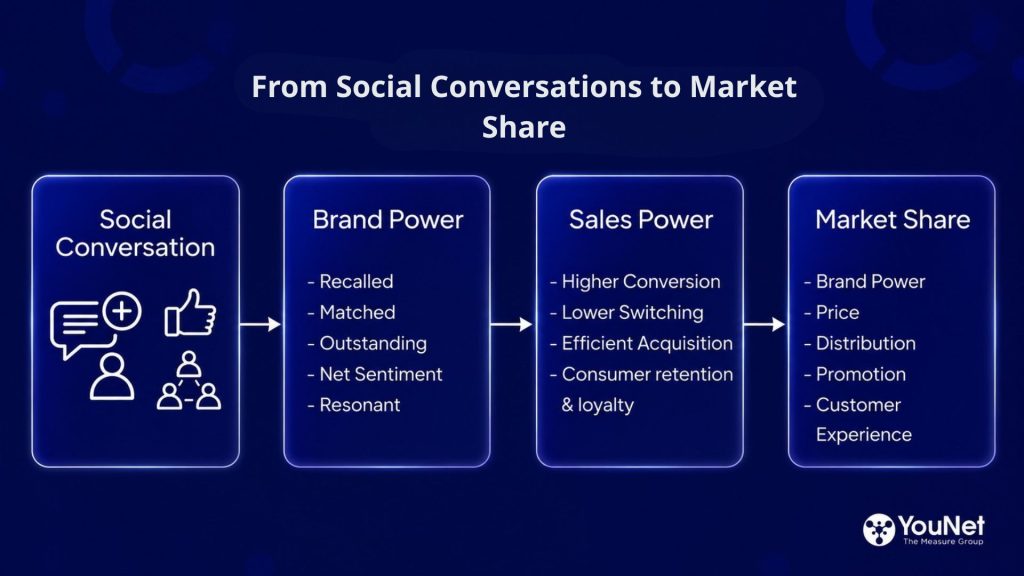
From Social Conversations to Market Share
Social data does not only reflect conversations. When interpreted correctly, social data reveals a structural linkage:
- Social Conversation
- Brand Power (SBHI)
- Sales Power
- Market Share
In other words, a brand’s activity on social media does not directly create sales, but it influences the structure that makes sales possible.
The issue is that most businesses still stop at measuring social conversations, while missing the more important layer: the Brand Power formed through those conversations.
From Social Conversations to Market Share
The Paradox of Modern Marketing: High Social Activity, But No Stronger Brand Power
Most businesses today have:
- A large volume of content
- Broad creator coverage
- Strong engagement
- Dashboards full of numbers
But when taking a longer-term view and asking: “After a period of social-first activity, has the brand become stronger or weaker compared with competitors?”. The answer is often unclear.
The issue is not a lack of data. It is the way data is being interpreted.
Today, social is often read through the lens of:
- Activities
- Short-term reactions
- Noise
While what businesses truly need to understand is: The structure of brand power in the mind of the market.
Social Brand Health Index: The Missing Measurement Layer in Brand Measurement
Social Brand Health Index (SBHI) was developed from this need.
SBHI does not measure noise or discussion volume. It measures brand power on social media.
A strong brand usually meets four conditions:
- It is recalled when a need arises
- It is chosen when users compare options
- It is trusted enough to reduce hesitation
- It sustains connection over time
Without these elements, a brand can still sell, but selling becomes harder, more resource-intensive, and more expensive.
As such, SBHI helps answer:
- How the brand is being remembered
- Whether the brand is associated with the right needs
- Whether the brand is distinctive enough to be chosen
- Whether trust is increasing or declining
- The level of resonance per user
A simple way to understand it:
Moving beyond counting social media activity, SBHI decodes brand power and how it can be translated into revenue.
SBHI Is Built on Qualified Users — The Foundation of Reliability
A key methodological difference of SBHI is:
SBHI is not measured on the full volume of social noise. It is calculated based on a set of Qualified Users.
Qualified Users are social profiles that:
- Show no signs of organized seeding
- Do not operate like mass content distribution accounts
- Have a high probability of being real users with natural social behavior
This allows SBHI to:
- Reduce noise from seeding, bots, and unnatural amplification
- Capture real perception and trust within society
- Reflect the quality of impact, not just the quantity of signals
The five components of SBHI are calculated on the Qualified User base, making SBHI more reliable for long-term strategic decisions.
Five Components, 20 Combinations, Converging into 4 Strategic Decisions
From a technical perspective, SBHI is built from five components:
- Recalled: Whether the brand comes to mind when a need arises
- Matched: Whether the brand is associated with the right user needs
- Outstanding: Whether the brand is distinctive enough in a comparison context
- Net Sentiment: The net emotional sentiment users hold toward the brand
- Resonant: The level of positive repetition per user
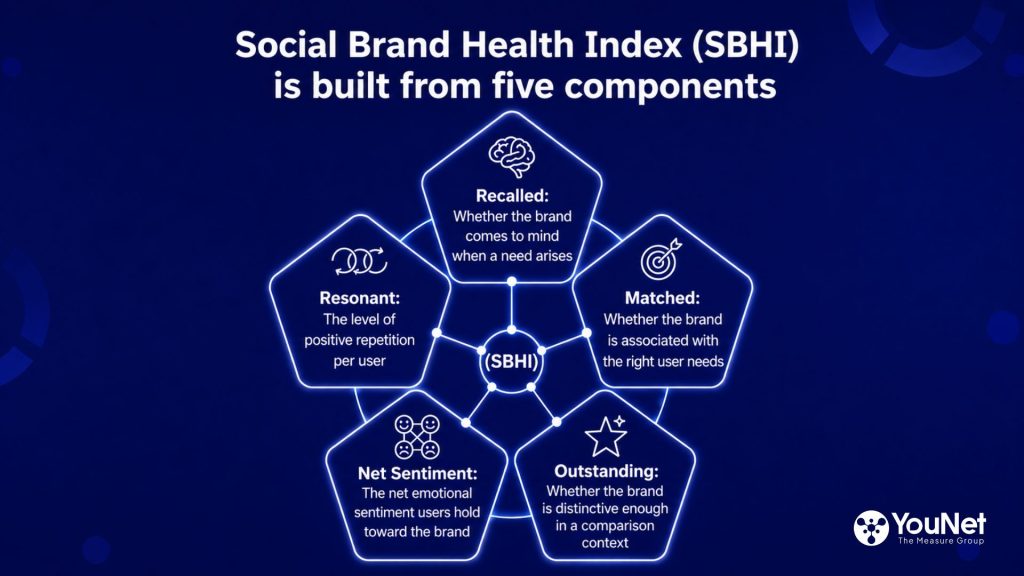
SBHI is built from five components
When combining 2 – 3 components, SBHI can generate multiple analytical combinations. However, at the strategic level, all of them converge into four major questions.
- Being recalled: (Recalled × Matched)
If the brand is not recalled at the right moment, social only creates noise.
- Being chosen: (Outstanding × foundational components)
This is where sales power is truly determined.
- Being trusted: (Net Sentiment × foundational components)
When trust declines, the cost of selling increases before sales starts to decline.
- Loyalty (Resonant × foundational components)
Connection does not come from saying more. It comes from being present in the right way and with meaningful relevance in social life.
When all four dimensions are strong:
- Selling becomes easier
- Marketing performance becomes more stable
- The brand gains a long-term competitive advantage
Empirical Evidence: SBHI and Market Share
YouNet Group’s research shows:
- Life Insurance Industry: correlation ≈ 0.6
- Powdered Milk Industry: correlation ≈ 0.66
Notably: Rank-order correlation exceeds 90%, indicating that SBHI reflects the competitive structure of a category with a high degree of accuracy.
It is important to understand this correctly: SBHI is not a revenue metric, but it reflects a foundational layer that has a strong relationship with sales potential.
SBHI Within the Sales Structure
Sales are always the result of multiple factors:
- Price
- Distribution
- Promotion
- Customer Experience
- Brand Power
SBHI measures the Brand Power layer.
When SBHI is high:
- Conversion friction is lower
- Acquisition costs become more efficient
- Marketing performance becomes more stable
Applications of SBHI in practice
SBHI is not a standalone report. It functions as an integral part of a marketing operating system where data, decisions, and actions are interconnected.
Within that system, SBHI plays the role of:
- A perception measurement layer
- A way to understand the state of Brand Power
- A foundation for decisions related to marketing and growth
SBHI is used to:
- Guide quarterly brand and social strategy
- Benchmark brand position against competitors
- Detect early risks related to trust and loyalty
- Decide whether to invest in presence, distinctiveness, or trust
SBHI does not answer: “What content should we create?”. SBHI helps businesses ask the right questions before spending money.
Implementation of SBHI at YouNet Group
SBHI does not stop at measurement, it is deployed across the entire ecosystem.
Measurement and consulting: YouNet Media and Buzzmetrics
- Measure SBHI
- Analyze Brand Power
- Advise on long-term strategy
Activation and impact creation: Mango Digital, YouNet Advocacy Marketing (YouNet AM), Fanscom
- Deploy marketing activities based on SBHI
- Optimize actions to improve Brand Power
- Create real impact in the market
These units do not replace the brand’s existing agency system. Instead, they play the role of:
- Piloting new approaches
- Executing initiatives to validate effectiveness
- Standardizing and packaging models
- Transferring proven models to the brand’s agency system
Why Is YouNet Group Announcing SBHI?
SBHI comes from a real problem: Marketing is being driven by:
- Beautiful metrics that are not connected to growth
- Short-term effects
- A race for buzz volume
YouNet Group believes that: When the way we measure changes, the way we execute changes accordingly.
SBHI is not designed to control creativity. SBHI exists to help marketing activities create real impact.
Conclusion
Social has become the center of marketing. However, without the right measurement layer, social only generates activity, not a competitive advantage.
Social Brand Health Index was built to:
- Connect social with brand
- Connect brand with sales
- Help businesses better understand the source of growth
Without a way to measure brand strength, marketing becomes very difficult to manage consistently.